

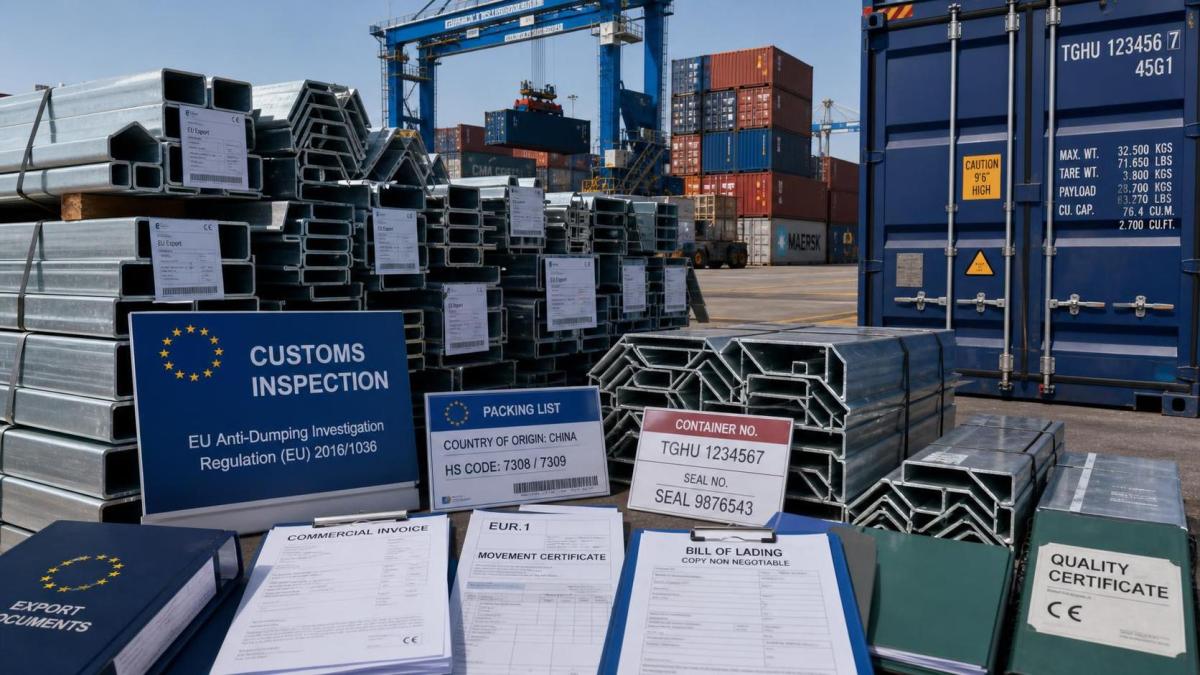
On July 26, 2026, the European Commission formally announced an anti-subsidy investigation into cold-formed steel products from China, identified as CSP under HS code 7308.90. For exporters, importers, distributors, and procurement teams linked to the EU market, this is not just a procedural trade update. It introduces an immediate compliance timeline, raises questions around customs handling and certification readiness, and may affect sourcing costs and delivery planning if the case moves toward temporary duties.
What the Commission Has Officially Announced
The confirmed facts are limited but commercially relevant. The European Commission issued a formal notice on July 26, 2026, opening an anti-subsidy investigation covering cold-formed steel originating in China. The products referenced are CSP under HS code 7308.90. Exporting companies involved in the case are required to submit questionnaire responses within 30 days. The summary provided also indicates that the investigation may directly affect customs clearance for EU importers, compliance and certification processes, and procurement costs, while leaving open the possibility of subsequent temporary duties.
Where the Pressure May Appear Across the Supply Chain
Export-facing transactions may face tighter document scrutiny
From an industry perspective, exporters tied to the affected product scope are likely to feel the first operational pressure through response deadlines and supporting documentation. The immediate issue is not only trade exposure but also whether product classification, transaction records, and compliance materials can be organized quickly enough to support business continuity during the investigation window.
EU importers may need to reassess customs and landed-cost assumptions
Analysis shows that EU importers are exposed on two fronts. One is customs handling, where ongoing shipments may require closer internal review of product scope and supporting paperwork. The other is cost planning, because the possibility of temporary duties creates uncertainty around landed cost calculations, contract execution, and margin protection for orders already under negotiation or pending clearance.
Distributors and channel partners may need to revisit supplier selection
For distributors and channel businesses, the more immediate concern is supplier qualification and supply-chain resilience. Observably, when a formal trade investigation begins, counterparties often need to recheck whether current suppliers can sustain documentation quality, shipment continuity, and compliance responsiveness. That makes supplier credibility and fallback sourcing arrangements more relevant than under normal purchasing conditions.
Procurement and compliance functions may need closer coordination
What deserves closer attention is the connection between sourcing decisions and compliance review. Procurement teams may need to confirm whether affected items remain viable under current purchasing plans, while compliance and certification personnel may need to verify whether technical files, declarations, and product-related records remain consistent with customs and market-entry requirements in the EU.
What Companies Should Track in the Near Term
The 30-day response window
Analysis shows that the stated 30-day questionnaire deadline is the clearest immediate operational signal in the current information set. Companies directly involved in exports should treat timing, internal responsibility, and document completeness as priority issues, because the investigation has already moved beyond a general policy discussion into a defined procedural stage.
Certification and compliance file consistency
Even though the input does not provide detailed execution rules, businesses should closely monitor whether certification-related files, technical descriptions, and customs-supporting documents remain aligned across sales, shipping, and compliance teams. This is particularly relevant where procurement or delivery decisions depend on uninterrupted market access and smooth importer processing.
Procurement schedules and delivery exposure
For buyers, importers, and distribution partners, it is reasonable to review order timing, delivery schedules, and sourcing concentration. This should be understood as a practical risk review rather than evidence of a confirmed disruption. The current notice creates a need to test whether existing purchasing plans can absorb changes in cost, timing, or supplier response quality.
Supplier qualification under trade pressure
Observably, supplier assessment may need to go beyond price and product fit. Companies may need to check whether suppliers can respond to investigation-related requests, maintain traceable records, and support downstream customers if customs, compliance, or tender documentation comes under closer review. The summary provided does not confirm any final restriction, so this remains a watchpoint rather than a concluded outcome.
Why This Looks More Like an Execution Signal Than a Final Outcome
Analysis shows that this development is best understood as an execution-stage trade signal rather than a settled market result. The formal launch of an anti-subsidy investigation, combined with a defined questionnaire deadline, indicates that affected companies already face procedural and commercial consequences. At the same time, the information provided does not establish a final duty decision or a completed enforcement outcome. For that reason, the market should avoid treating the case as fully resolved while also avoiding the opposite mistake of viewing it as merely symbolic.
From an industry perspective, continued attention should focus on how official language, compliance expectations, procurement documents, and market responses evolve after the opening notice. Those details will matter more to day-to-day business execution than broad commentary alone.
How the Market May Best Read This Development Now
At this stage, the case is more appropriate to understand as a live regulatory and trade development with immediate procedural impact and still-open commercial consequences. The confirmed facts already justify closer review of customs handling, certification readiness, procurement assumptions, and supplier resilience. However, the final scale of impact still depends on how the investigation progresses and how market participants adjust in practice. A measured reading is therefore more useful than a definitive conclusion.
Basis of This Article and What Still Needs Verification
This article is based on the user-provided news title, event date, and event summary concerning the European Commission's July 26, 2026 anti-subsidy investigation into Chinese cold-formed steel products. For developments of this type, relevant source categories typically include official notices, releases from regulatory authorities, customs or trade administration information, industry association updates, standard-setting documents, and reporting from established business media. No specific official source link was provided in the input, so the exact source document link still requires follow-up verification. It remains necessary to continue checking later official wording, certification and compliance interpretation, tender-document changes, industry feedback, and how affected companies implement their responses.
By clicking 'Allow All', you agree to the storage of cookies on your device to enhance site navigation, analyze site usage and assist with our marketing efforts. Coo Cookie Notice