
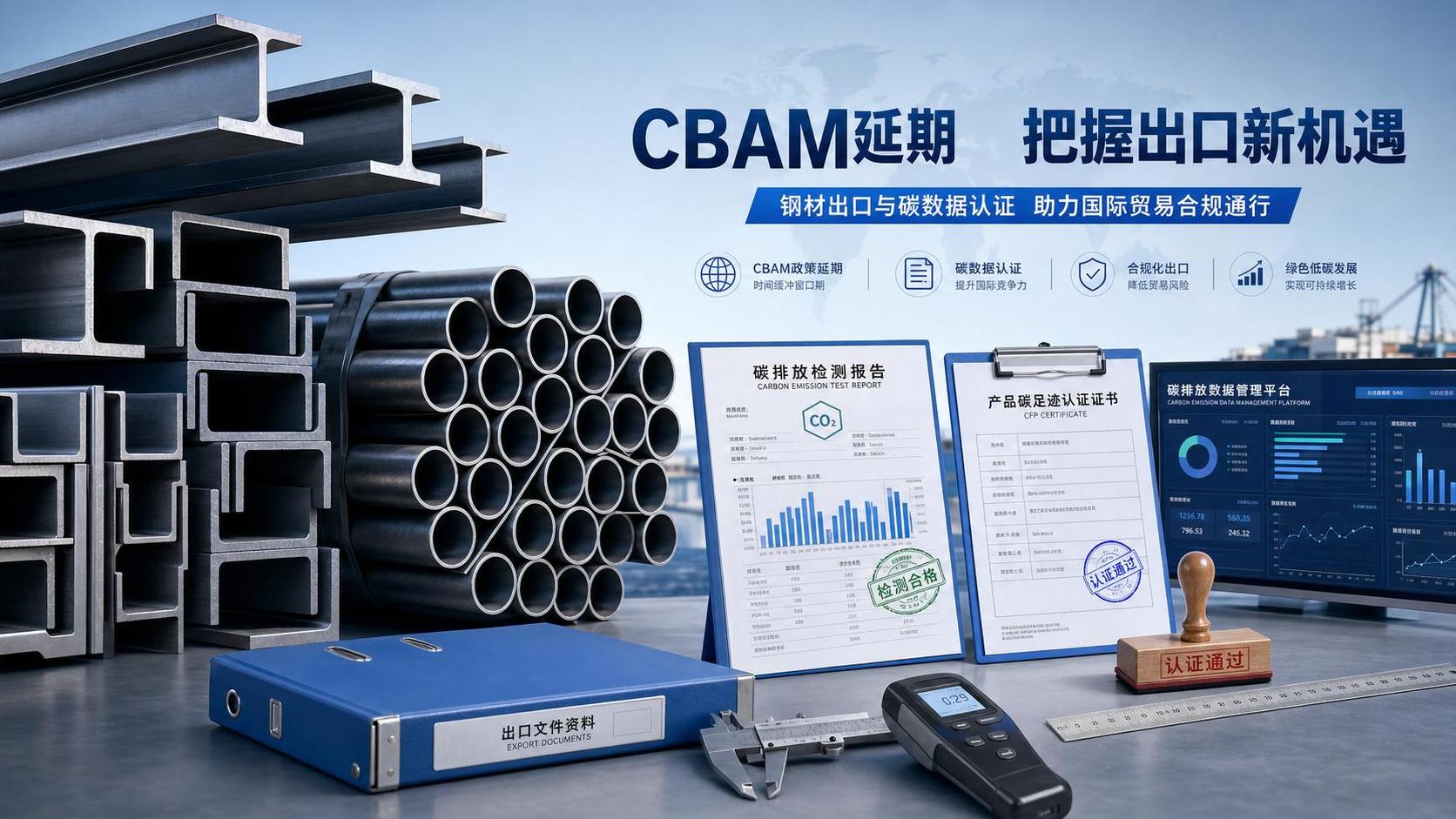
On July 16, 2026, the European Commission announced that the CBAM transition period for certain non-flat steel products, including sections and seamless pipes, will be postponed from October 2026 to October 2027. The change matters to exporters, importers, manufacturers, certification-related service providers, and supply chain partners because it shifts the timetable for carbon data preparation while keeping the compliance direction clear: from 2027, importers will need certified embedded emissions data and will have to purchase CBAM certificates.

A Revised Timeline for Non-Flat Steel Under CBAM
The confirmed change is limited but operationally important. According to the information provided, the European Commission formally stated on July 16, 2026 that the planned extension of the CBAM transition period to non-flat steel categories such as sections and seamless pipes, originally set for October 2026, has been deferred to October 2027.
The same information indicates that, starting in 2027, importers will be required to submit certified embedded carbon emissions data and purchase CBAM certificates. The announced postponement effectively creates a 12-month buffer for exporting companies to build carbon accounting systems, complete third-party verification and certification, and improve carbon data coordination across the supply chain.
Where the Practical Pressure Now Shifts
Export-facing steel suppliers now have more preparation time
From an industry perspective, exporters of the affected steel products are likely to feel the impact first because the delay changes the immediate compliance timetable without removing the need for preparation. The main effect is on product-level emissions accounting, document readiness, and communication with overseas customers. What deserves closer attention is whether internal data systems, supporting records, and external verification arrangements can be organized in time for the later implementation point.
Importers and procurement teams will need earlier document alignment
For importers and procurement functions, the shift is less about the policy headline and more about the evidence chain behind future declarations. Once certified embedded emissions data becomes a requirement, purchasing decisions, supplier selection, and contract documentation may increasingly need to reflect whether upstream partners can provide verified carbon information. Analysis shows that this can affect pre-shipment document review, supplier qualification checks, and delivery planning tied to compliance readiness.
Certification and verification-related service providers may see a staged demand pattern
Certification-related companies, third-party verification bodies, and supply chain data support providers may also be affected because the additional year does not remove demand; it redistributes it over a longer preparation cycle. Observably, the relevant business links are likely to include emissions data verification, consistency checks across supply tiers, and coordination around certified reporting materials rather than only final filing activity.
Supply chain coordination becomes part of delivery risk management
Manufacturers, traders, and logistics-linked service partners may need to treat carbon data readiness as part of shipment execution rather than as a separate sustainability issue. If embedded emissions information must ultimately be certified and submitted, incomplete upstream data or inconsistent supporting records could affect order handling, customer acceptance, or delivery sequencing. At this stage, the key change is the growing connection between compliance preparation and routine supply chain execution.
What Companies Should Track During the Extra 12 Months
Readiness of carbon accounting systems
Analysis shows that the additional buffer period is most useful only if companies use it to establish or refine carbon accounting processes for the affected products. The current issue is not whether the requirement exists, but whether internal systems can produce emissions data in a form that can later support certification and importer use.
Third-party verification and certification workflow
What deserves closer attention is the practical sequence between internal data collection and external verification. Because the provided information specifically mentions third-party verification and certification, companies should closely watch how their documentation, technical records, and supporting evidence can be organized for external review once implementation draws nearer. Where detailed execution guidance has not been provided, this remains a preparation point rather than a confirmed filing outcome.
Coordination with customers and upstream suppliers
For exporters and supply chain managers, the announced delay should also be read as a coordination window. Embedded emissions data cannot usually be managed by one party alone if multiple production or sourcing links are involved. Companies should therefore pay attention to supplier data consistency, customer information requests, and whether procurement and delivery schedules need to incorporate compliance-related documentation checkpoints.
Changes in trade documents and commercial terms
It is more appropriate to understand this stage as a signal to review future document requirements rather than as evidence of completed market adjustment. Businesses should monitor whether quotations, contracts, technical files, declarations, or tender-related documents begin to reference certified emissions data or CBAM-related readiness. The current information does not confirm specific document formats, so this remains an area for continued observation.
Why This Looks More Like an Execution Signal Than a Policy Reversal
Observably, this development should not be read as a withdrawal of the compliance direction. The confirmed change is the timing of the transition period for certain steel products, while the requirement for certified embedded emissions data and CBAM certificate purchases from 2027 remains part of the announced framework. Analysis shows that the industry significance lies in the additional implementation window, not in any indication that carbon-linked import compliance has lost relevance.
It is also more appropriate to understand this as a rule dynamic that still requires follow-up observation. The announcement clarifies timing, but market participants will still need to watch how official wording, certification practice, customer requirements, and supply chain document expectations develop as the postponed date approaches.
How the Market Is Likely to Read the Announcement
In practical terms, the announcement gives affected companies more time, but it also makes preparation harder to postpone internally. The industry meaning is not simply that enforcement has moved back by 12 months. Rather, the update signals that emissions accounting, third-party verification, and supply chain carbon data coordination are becoming more directly tied to future trade execution for the covered steel products.
From an industry perspective, the most balanced reading is that this is a confirmed timetable change combined with a continuing compliance signal. Companies do not yet have all execution details in the information provided here, but they do have a clearer indication that readiness work should continue during the extended transition period.
Basis of This Article and What Still Needs Verification
This article is based on the user-provided news title, event date, and event summary concerning the July 16, 2026 announcement on the delayed CBAM transition period for certain steel products. For developments of this kind, commonly relevant source types may include official announcements, regulatory releases, customs or trade authority notices, industry association updates, standards-related documents, and reporting by authoritative media.
A specific official source link was not provided in the input, so the exact official publication path still needs to be verified on an ongoing basis. Further observation is also needed on detailed policy wording, certification implementation approaches, tender and contract language changes, market feedback, and how affected companies translate the announced timetable into actual compliance preparation.
By clicking 'Allow All', you agree to the storage of cookies on your device to enhance site navigation, analyze site usage and assist with our marketing efforts. Coo Cookie Notice